

I’m calling it. The VC-backed ecommerce returns industry is officially dead.
It hit me as I considered covering the recent acquisitions of Frate by Route, ReturnLogic by Redo and iF Returns by ReturnPro and found myself uncertain about covering them due to how small these deals probably were compared to the normal M&A I cover.
That’s when it hit me. The excitement and hype around ecommerce returns as a unicorn factory was dead.
Covid + Returns: The opportunity was real
VCs were not wrong to fund returns. Returns took front and center stage when Covid hit, stores shuttered, and the entire world took to ecommerce. VCs correctly identified that capital investment in returns was underfunded.
Collectively, VCs poured $403.4 million into returns and reverse-logistics specialists, and $219 million into post-purchase platforms.
Today, global retail ecommerce sales are expected to hit $6.88 trillion in 2026. A tiny 10% piece of that action for returns means about $688 billion in sales.
The global ecommerce logistics market is expected to hit $624.33 billion, so similarly a 10% piece of that action for returns would be $62.43 billion. VCs start getting giddy at $50 billion.
But not a single returns unicorn emerged. What happened?
Flanked on Two Sides
Ecommerce Returns is a classic case where the giant incumbents entered the market and seized the upside for themselves.
On the Returns Management Solutions (RMS) side, platforms and retailers added significant capabilities to their returns offerings to nip specialists and post-purchase players in the bud.
On the physical returns logistics side, once the sleeping logistics giants woke up, no start-up was safe.
Platforms and retailers took over the workflow
The first Returns Management Solutions (RMS) offered branded returns portals, return reasons, shipping labels, refunds and exchanges, store credit, rules and analytics.
RMS were highly innovative and valuable products when they launched - but their products were built on leased land.
The majority of them focused their offerings on Shopify - a platform which owned the order, payment, customer account, product catalogue, inventory record and merchant relationship.
Then, in 2018, Shopify acquired Return Magic.
The fact that Shopify ultimately sunset the product and positioned the acquisition as an acquihire didn’t matter. The message was clear: Shopify would be developing returns solutions in-house.
Not long afterwards, Shopify went a step further and invested into Loop Returns. Rumours wafted that Shopify would eventually acquire Loop, and those rumours were further reinforced when it participated in Loop’s $65M Series B.
But then something peculiar happened that nobody expected. Loop reduced headcount, and its founder and CEO stepped down, later resurfacing publicly as an advisor to Shopify. While not officially confirmed, it would be logical for the advisory role to apply towards Shopify’s native returns product.
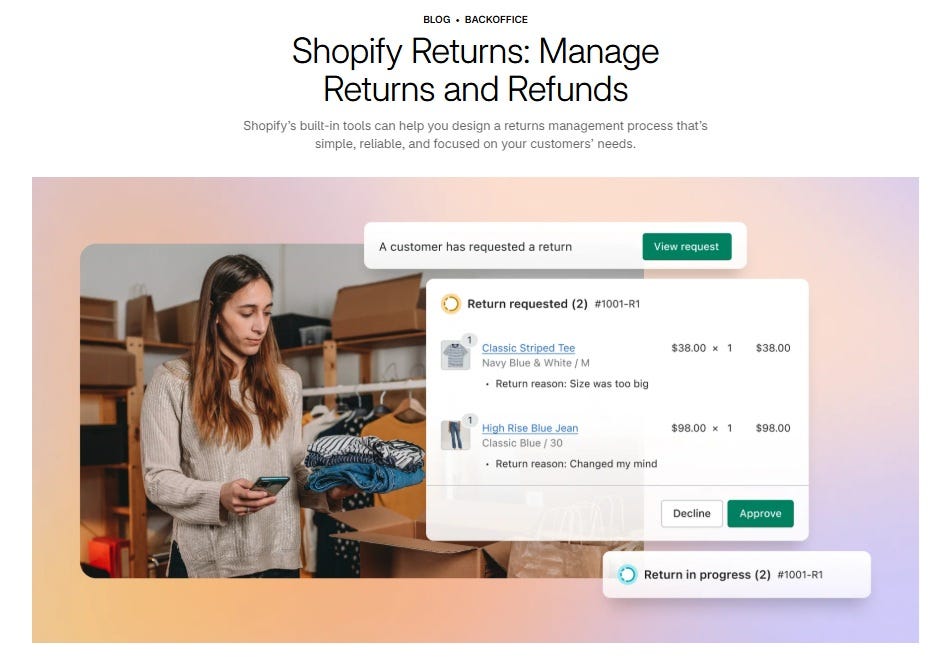
Today, Shopify’s native self-serve returns feature covers customer return requests, merchant approval or decline, return instructions, notifications and tracking. Shopify’s returns apps and APIs additionally support rules, labels, exchanges, refunds and related workflow automation.
Similarly, Salesforce Order Management supports managed and unmanaged RMA return orders, quantity received and rejected tracking, refunds and credit memos. Exchanges and flow behaviour require the applicable configuration.
The result is that returns specialists are stuck in a never-ending rat race of adding new features and innovations just to stay slightly ahead of Shopify, who may decide to copy the features for its native offering.
Logistics giants own the physical return
Startups and their VC investors often know that they are racing against time to scale before large industry players get into the game.
Startup Shyp was an early entrant into the returns business. It built an on-demand shipping and returns model, raising roughly US$62–63 million with one major use case being picking up returns from consumers and helping them ship those returns back to merchants.
For the physical-world returns space, where returns need labels or QR codes, a hand-off point, collection, scanning, consolidation, linehaul, sortation, processing, inspection and a next commercial outcome . . . scaling the physical world proves both difficult and bloodydamn expensive.
Startups like Shyp offered limited city coverage, but the enterprise merchants desperately need to court wanted nation-wide solutions.
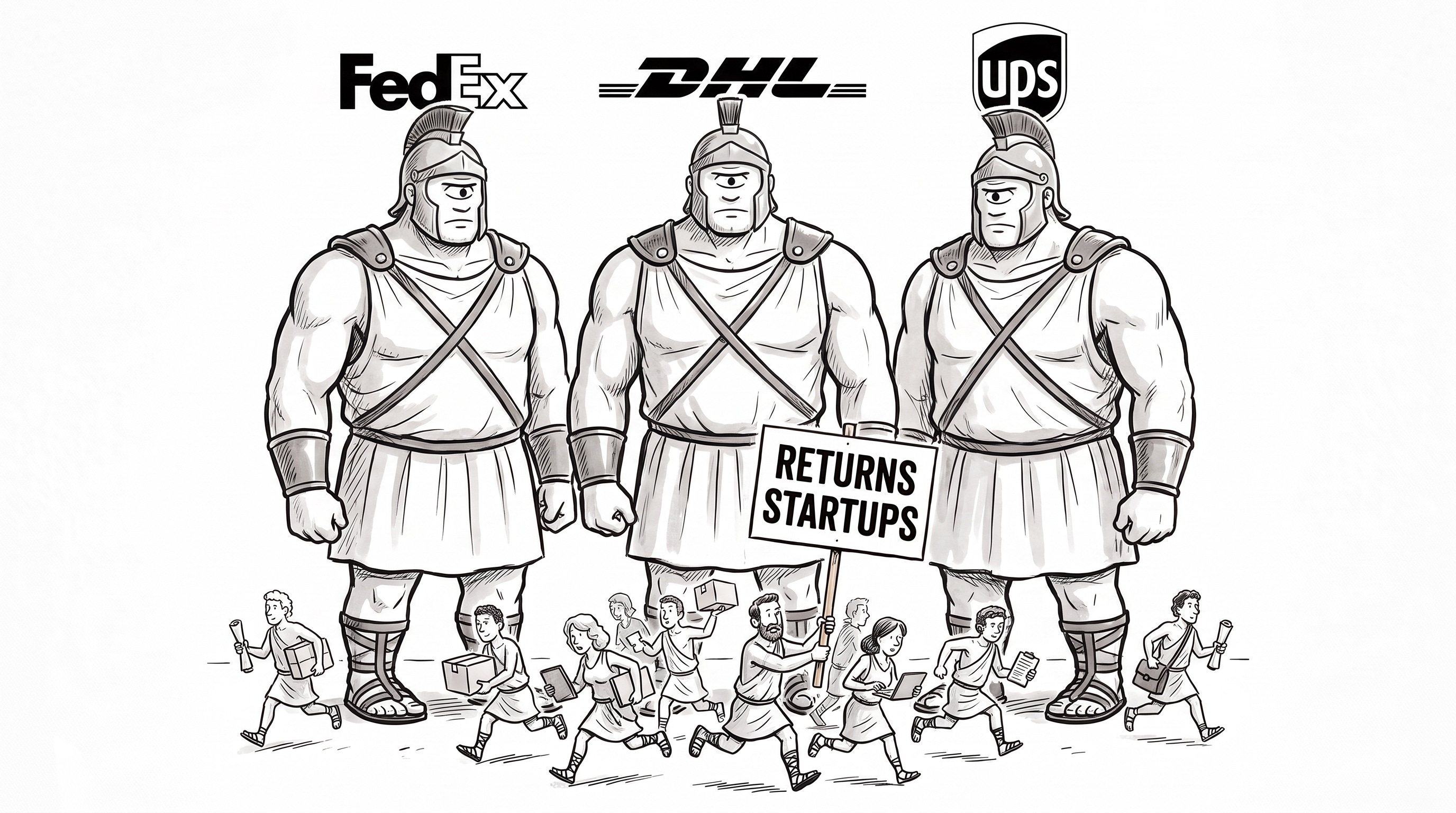
Once the big logistics giants like UPS, FedEx, DHL, DPD, GLS, started waking up to the opportunity, their existing national route density, drivers, vehicles, support, failed-pickup handling, terminals and service footprints - and their national sales teams - were impossible to match.
In 2018, Shyp shuttered its operations after first shrinking back to a San Francisco-only operation.
Which Returns companies succeeded?
Despite the returns startup industry’s challenges, a few notable first-to-scale players have achieved success.
None stands out more than Happy Returns. Happy Returns built a two-sided returns network and was acquired by PayPal in 2021, then UPS in 2023. The official announcements did not disclose prices. Later reporting quoted Happy Returns CEO David Sobie as saying PayPal paid US$265 million and UPS paid US$465 million.
ReBOUND, founded in 2014, offered global RMS and physical returns management. Reconomy acquired the company in 2021 and later combined its capabilities with Cycleon.
ZigZag, founded in 2015, directly competed with ReBOUND on a similar offering. It was acquired by Global Blue which raised $70 million in equity to fund the acquisition, although neither ZigZag’s purchase price nor valuation were ever disclosed.
ReturnGO’s acquisition by Global-e will be one of the last great acquisitions in the returns space that we’ll see in a while.
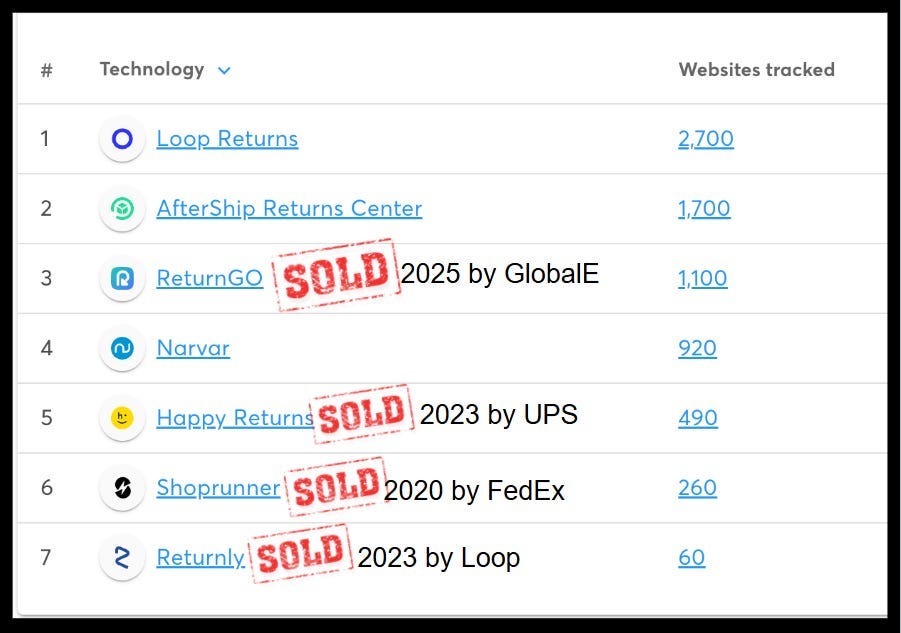
I previously published ReturnGO acquisition analysis. After this, all remaining eyes are on Loop Returns to put Returns back on the map. But with Loop diversifying into tracking and shipping aggregation, it’s looking increasingly like another post-purchase suite.
Resale Platforms: A Second Wind, or Second Reckoning?
With returns maturing and the economy going K-shaped, resale enablement platforms have been raising venture capital. Resale is the natural next step after returns.
Every returned item raises the next question: restock, refurbish, resell, liquidate, donate or recycle?
Archive raised US$30 million in 2025 to further develop resale intelligence software and support infrastructure and global expansion.
Faume raised €8 million in 2025 to support European expansion and strengthen its sales and tech teams.
Swap raised US$40 million in 2025 for an ecommerce operating system spanning inventory, cross-border, returns, shipping and logistics.
Trove raised US$30 million in a 2023 Series E, bringing its total funding to more than US$150 million. It combines branded resale and trade-in with condition grading, site build, warehouse and logistics capabilities.
Treet raised US$10 million in a 2024 Series A. It is the more asset-light version: branded off-price and returns, peer-to-peer and trade-in resale models. At the time, Treet said it had launched 150 branded resale programs.
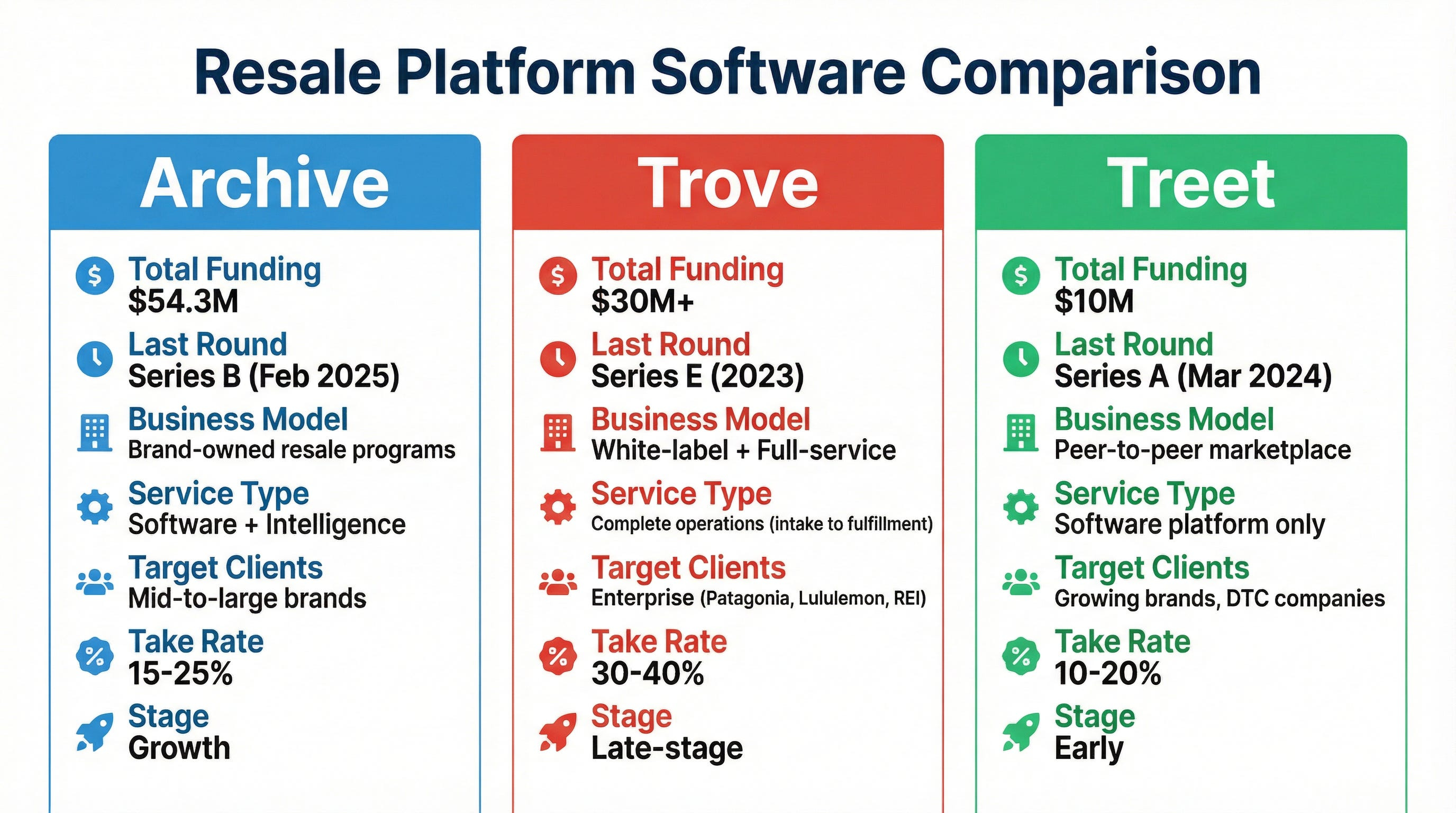
Previously published comparison of Archive, Trove and Treet.
What’s next for Ecommerce Returns?
While there will always be exceptional startups in any industry, the VC-backed model for ecommerce returns is largely dead, and the battleground has shifted towards a battle of the titans.
On the software side, marketplaces and platforms are directly dueling it out for the best features, including returns.
On the physical logistics side, whether it’s UPS’ continued development of Happy Returns, FedEx’s role in the €7.8 billion consortium offer for InPost, or the 4M returns a day that Amazon processes mostly in-house, the battleground for returns has moved into the major leagues.