

A lot of eyes are on Hongkong Post for reporting an $821M HKD operating loss — the worst in its 29 year history. What happened exactly?
Former Postmaster General Leonia Tai Shuk-yiu said: “We are facing a continued decline in mail traffic, with fewer people sending mail in traditional formats.”
Additionally, a LegCo paper citing CEDB cites terminal dues (i.e. the cost that HKPO pays to destination post offices for cross-border mail) indicating that “HKP is operating at higher costs.”
According to the Universal Postal Union (UPU), posts worldwide are collectively suffering from the same irreversible drop in letter-mail volumes. While terminal dues have increased, however, HKPO pays the same base level terminal dues as other developed APAC countries.
If that is the case, then why is Hongkong Post performing the worst out of all its developed-market APAC peers?
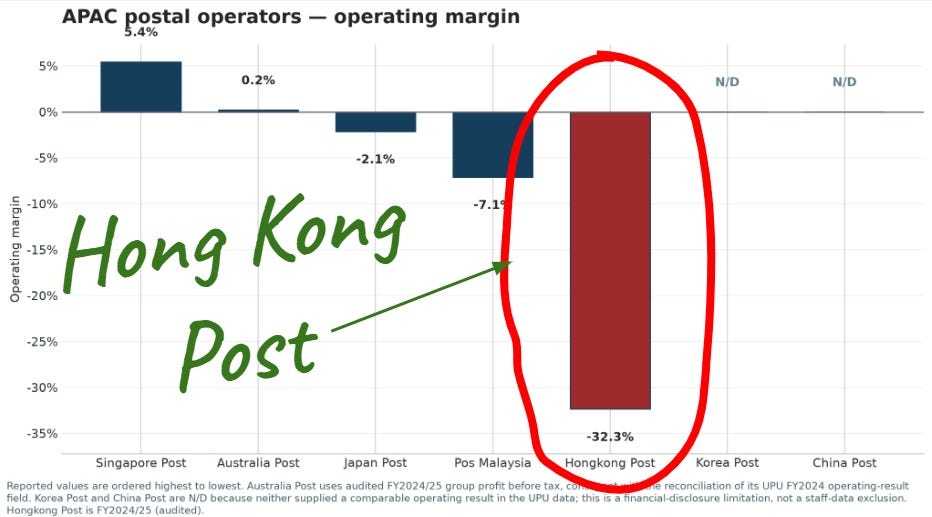
Hongkong Post’s 2025 operating margin was –32.3%. Compared to SingPost, AusPost, Japan Post, and Pos Malaysia, the gap is substantial.
Before we can understand why, we first need to understand the external market conditions and how they impacted Hongkong Post’s development over its lifetime.
1970 - 1995: The Early Growth Years
Hong Kong Post’s early story is linked to rapid growth of Hong Kong as an emerging global trading and financial hub in the 1970’s-1980’s. As the city began to flourish, more mail was being sent both domestically and internationally than ever before. HKPO’s Speedpost product launched in 1973 and the International Mail Centre opened in 1980.
As Mainland China’s manufacturing base grew in the 1990s along with sophisticated capital markets, so did Hong Kong’s role in acting as a gateway for the business and services that followed.
1995 - 2010: Trading Fund Begins
The Post Office Trading Fund began operating in 1995, effectively allowing HKPO to operate like a commercial enterprise. This allowed the post to launch commercial services such as express mail. HKPO flourished along with Hong Kong.
2010–2018 The Ecommerce Boom
The 2010s marked a golden age for Hong Kong’s ecommerce scene. As a global trading hub, Hong Kong had long been known as a shopper’s paradise, especially in categories such as health and beauty, fashion and apparel, and consumer electronics. Hong Kong trading firms positioned the city as having the newest and most attractive products at the most competitive prices. Its positioning as a gateway between Mainland China and the rest of the world brought great prosperity to the city.
So when cross-border ecommerce finally arrived on the scene, HKPO’s infrastructure was perfectly positioned to help businesses ship their parcels in large volumes to customers all around the world.
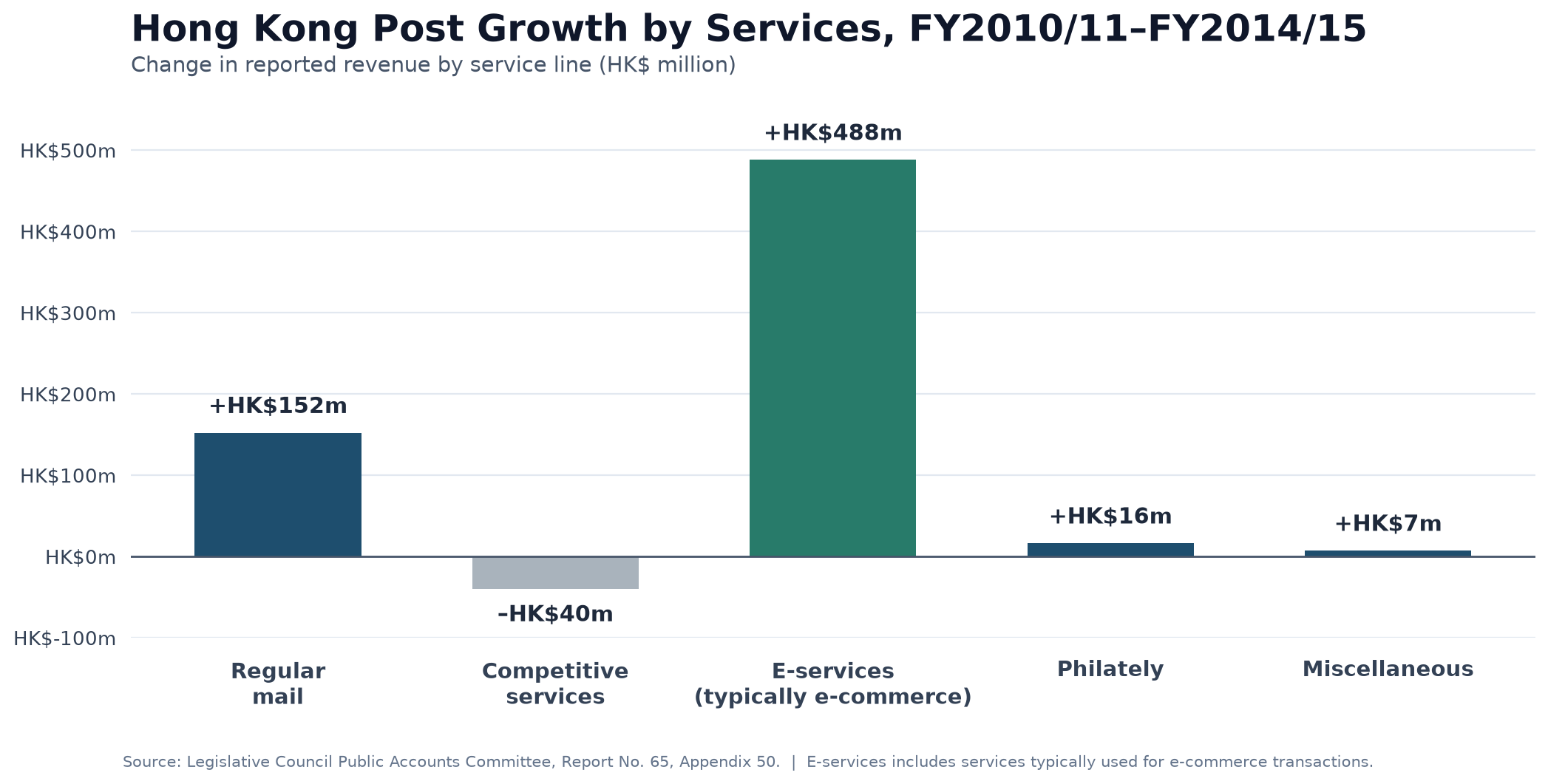
Between 2011–2015 alone, its ecommerce logistics services Bulk Air Mail, e-Express, iMail, Smart Post and e-EMS grew HK$488.1 million, accounting for 78.4% of the reported revenue increase.
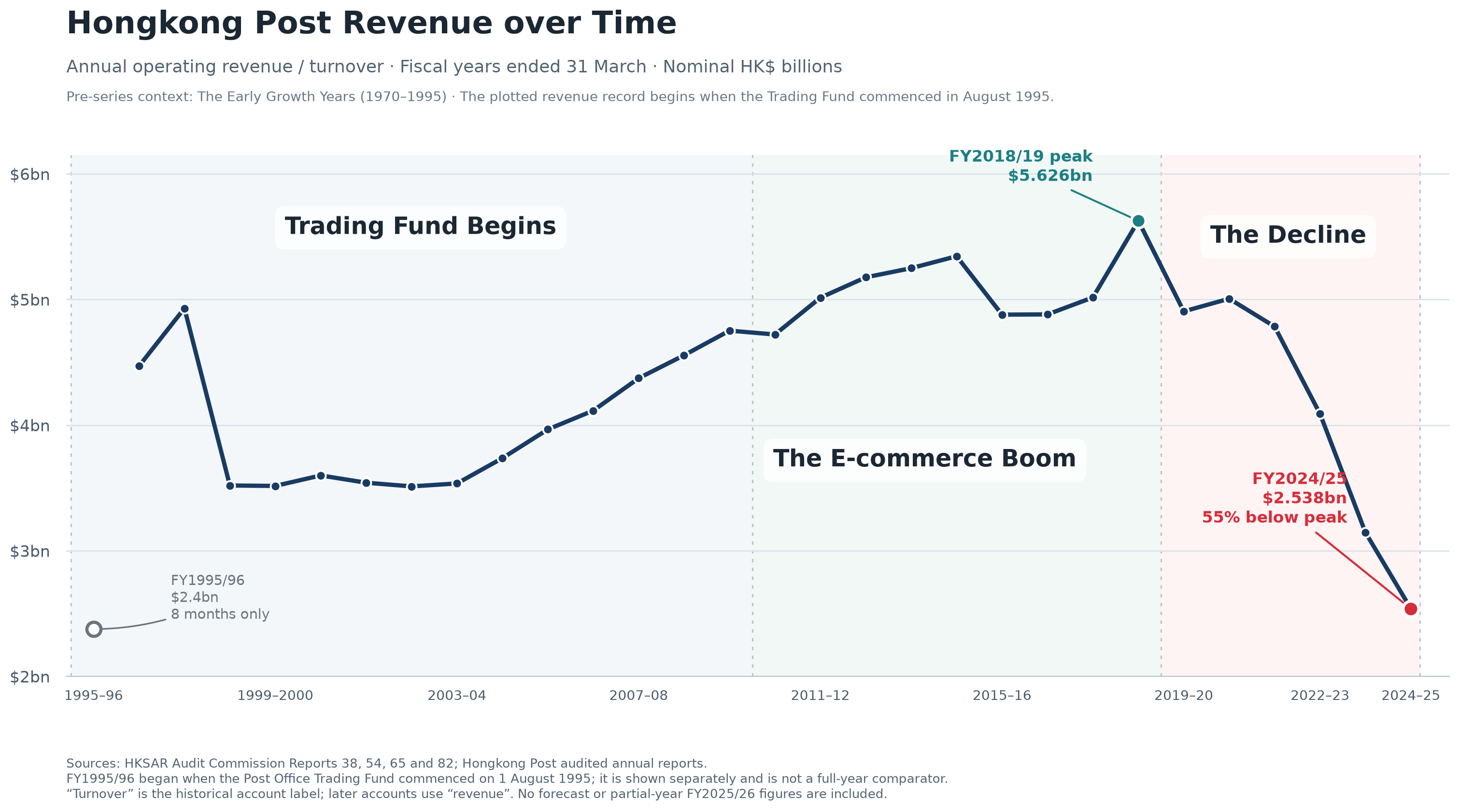
By 2018, its operating revenue rose to a peak of HK$5.626 billion.
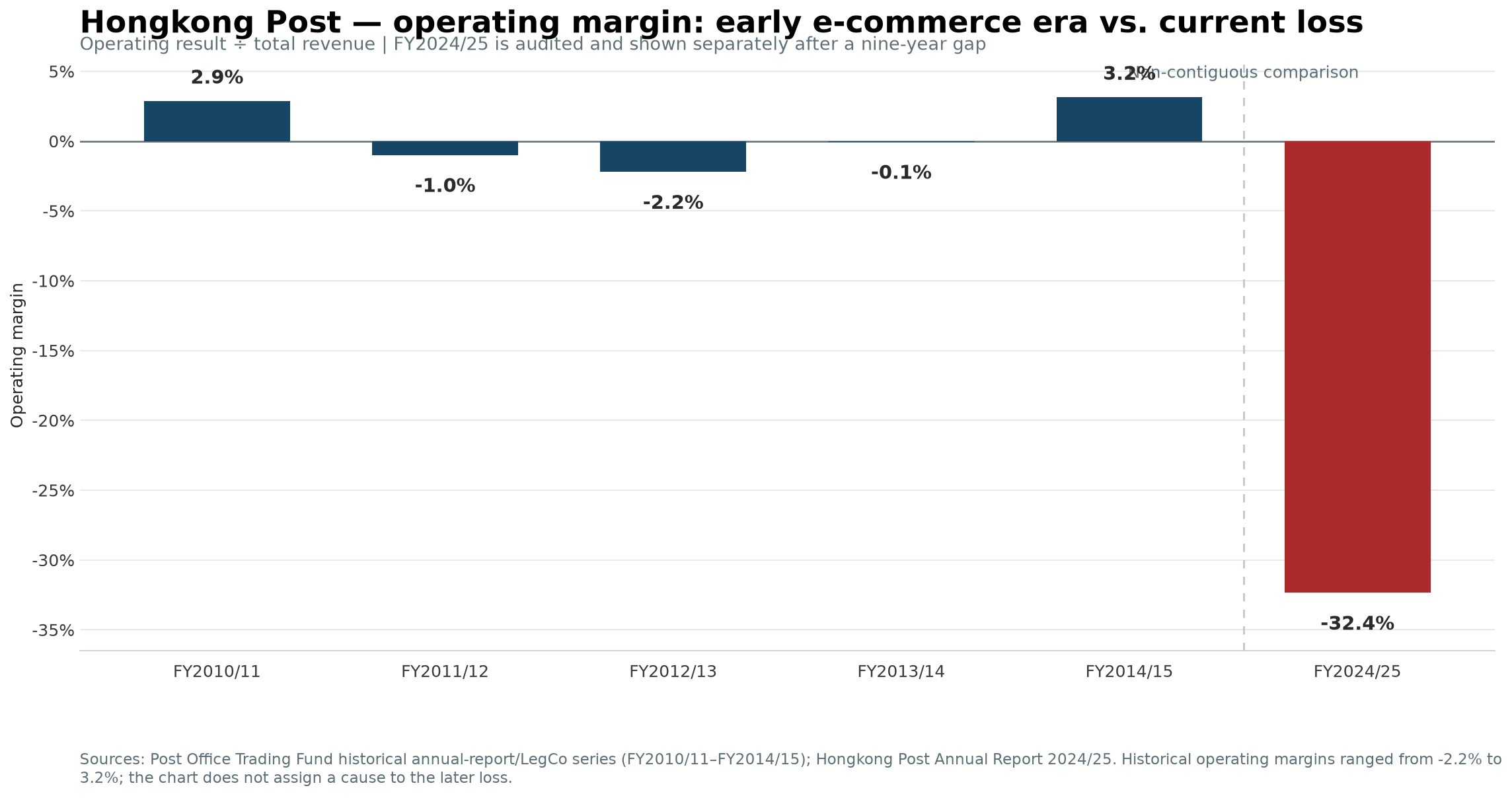
Operating margins from 2011–2015 averaged 0.56% versus -32.4% today.
Late 2010s: The Decline Arc
By the late 2010s, however, multiple changes in the market would begin to converge to create substantial challenges for Hong Kong Post.
Act 1: Domestic Challenges
1. Letter Mail Decline (ie the mail-pocalypse)
First came the fax machines. Then the email. Today - mobile phone instant notifications. Letter mail volumes around the world have been experiencing a steady and irreversible decline as senders continue the move towards digital communication.
As a digitally advanced city, Hongkong Post was not immune to the effects. Local letter-mail volumes have fallen 45.6% from 2016 to 2025.
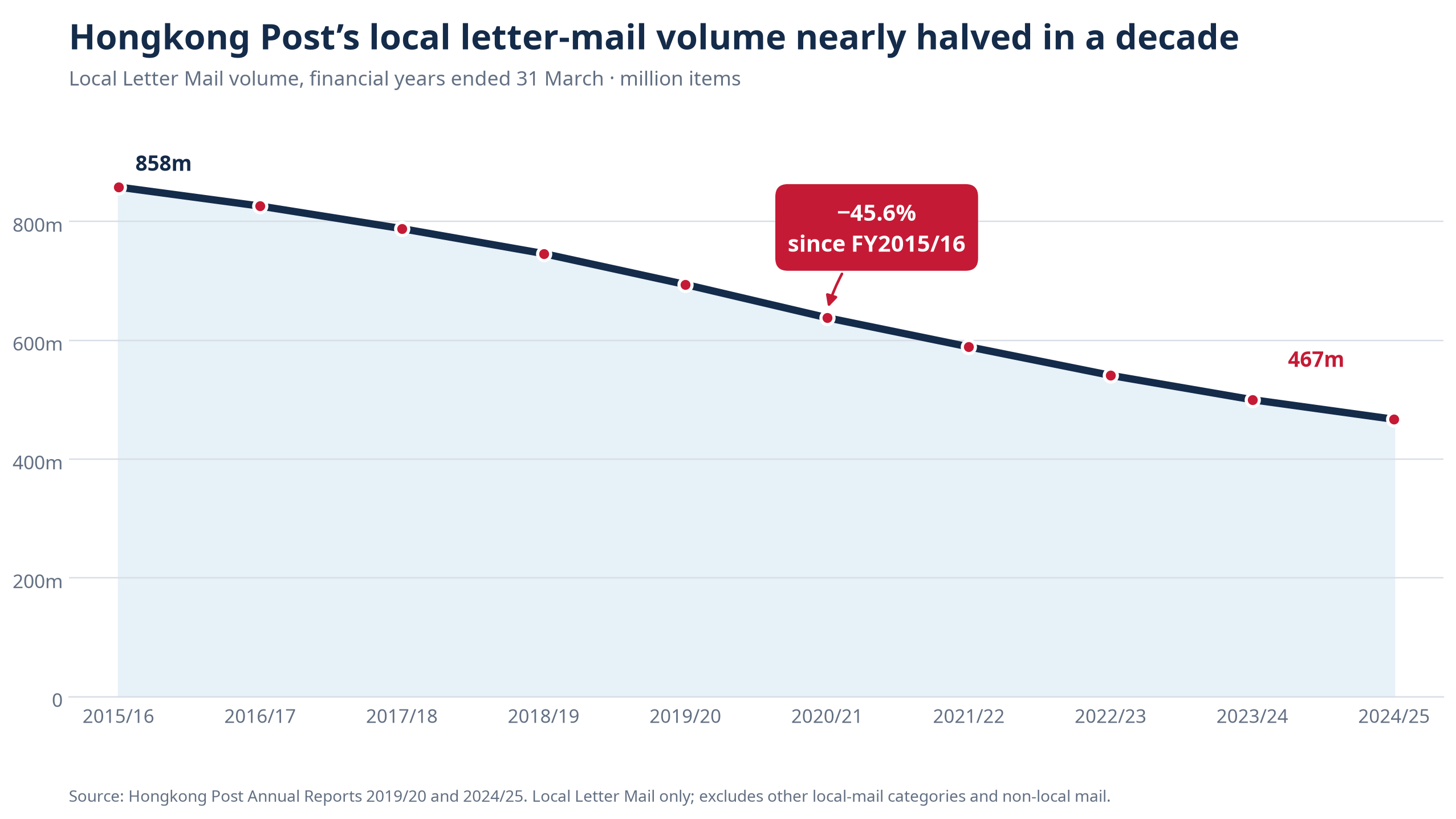
The letter mail decline shows no signs of reversal and HKPO must plan for continued decreases in letter mail.
2. Competition from Parcel Carriers
In every country, the domestic post typically enjoys several advantages:
A first mover (or early mover) advantage
An infrastructure and scale advantage
A branding and trust advantage
Hongkong Post benefited from all three in its early and golden years. As Hong Kong prospered, however, private delivery companies entered the market, creating competition with HKPO through differentiated products, competitive pricing, account management and customer servicing.
Despite its early advantages, as a public government department operating under a Trading Fund business model, Hong Kong Post could not keep up with the speed and innovation of the private sector.
Today, the domestic parcel-delivery market is dominated by SF Express, Cainiao, and JD Logistics. The premium express market is led by DHL Express, FedEx, and UPS. Point-to-point delivery from GoGoX and LalaMove solves customers’ instant needs.
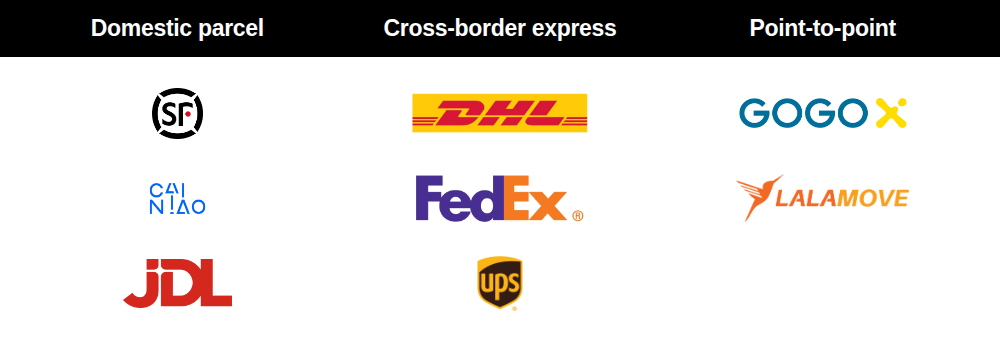
Private sector carriers can structure services around merchant technology, on-demand pickup, time-specific delivery, account management, warehousing, fulfilment, return flows and clearance. Cainiao, for example, launched local B2C and C2C services in Hong Kong in 2024 and reported more than 1,000 self-pickup points, including more than 450 with Sunday or evening operations.
While Hongkong Post offers local e-commerce products, the market has long chosen the winners. Just visit any housing estate or any office building. Parcels are rarely delivered by HKPO anymore, and letters of any urgency are delivered domestically by SF and internationally by the Big 3 express carriers.
3. Hong Kong gets Disintermediated (domestic)
As Mainland China opened up, and as Hong Kong consumers became more savvy and started buying directly from online retailers overseas such as Taobao and Amazon, thereby cutting out the Hong Kong enterprises that previously made their money by importing and distributed those products locally.
By cutting out the middleman, however, consumers also cut Hong Kong Post out of the loop. Rather than buying from a local merchant that would ship the product locally using Hong Kong Post or another domestic carrier, international retailers such as Taobao shipped directly from overseas with carriers such as Cainiao.
Act 2: Cross Border Challenges
1. Terminal Dues Increased
In 2010, Hong Kong, China entered the Universal Postal Union (UPU) target terminal-dues system.
Universal Postal Union: A specialized agency of the United Nations that coordinates international postal policies, standards, and operational frameworks among member nations to ensure a seamless global postal network.
Terminal dues: Standardized compensatory fees that a destination postal administration (eg USPS, Canada Post, Royal Mail, Auspost) charges a dispatching country’s postal service (ie HKPO) to cover the domestic handling and delivery costs of incoming international mail items and small packets.
Hongkong Post warned in 2010 that the new mechanism, which would phase in from 2014, would bring a significant rise in terminal-dues expenditure over the current and coming years.
Terminal dues are a direct cost of servicing. Any direct servicing cost will put either pressure on raising prices or reducing margins. Fortunately, no further changes are expected from terminal dues.
Thanks to both a strong economy and ecommerce from 2014–2018, the effects of terminal dues were blended into overall positive results, but after 2019, as the boom years faded, the impact of higher terminal-dues costs became very evident in the unit economics (i.e. operating margins).
2. Hong Kong gets Disintermediated (crossborder)
In the beginning, Hong Kong merchants held several advantages in cross-border ecommerce, including foreign-language marketing, understanding culture, cross-border payments, and cross-border shipping.
As China’s economy grew, its ecommerce merchants became more sophisticated. Year over year, Mainland Chinese companies rapidly caught up to the capabilities of their Hong Kong counterparts.
The world’s largest platforms, such as eBay and Amazon, set up logistics infrastructure and teams to help Chinese merchants reach customers worldwide. By the late 2020s, Mainland China’s merchants did not just become better at selling online; they overtook Hong Kong merchants by a wide margin.
Today, homegrown Mainland Chinese companies like Shein, Temu, and AliExpress dominate cross-border ecommerce, and arguably the entirety of ecommerce from multiple perspectives. Shein will become the world’s largest apparel retailer by 2027. Amazon’s Chinese sellers account for the majority of transactions on its US marketplace.
That business is gone from Hong Kong merchants and will never come back.
3. Hongkong Post can’t ship Consumer Electronics and Beauty — two critical categories
Consumer electronics and beauty are two of the biggest categories in ecommerce globally. They also contain two types of products that Hongkong Post can’t ship overseas — items with batteries and liquids (a.k.a. D.G. or Dangerous Goods).
Consumer Electronics with Batteries = Mobile phones, tablets, chargers, beauty devices, portable fans, drones and remote control toys, digital cameras, IOT home devices, etc.
Beauty Items with Liquids = Perfumes, colognes, body mists, liquid foundations, concealers, serums, toners, face oils, lotions, face/body creams, shampoos, conditioners, soaps, body washes, nail polishes, nail polish removers, hair dyes, liquid eyeliner, mascara, lip glosses, setting sprays, sunscreens.
Hongkong Post tells customers not to post lithium batteries and specifically identifies smartphones, tablets, beauty devices and other battery-containing products as common security-inspection issues.
But this limitation doesn’t stop Hong Kong Post’s competitors. In fact, despite disintermediation, Hong Kong’s air-cargo industry is uniquely positioned to service China’s dangerous-goods shipments. These eligible dangerous goods can move through Hong Kong’s regulated freight channels when the shipper, forwarder and airline meet strict requirements on classification, packaging, marking, labelling, documentation and carrier approval.
This unique capability of Hong Kong’s airfreight industry is one of the key reasons that Hong Kong remains the #1 airfreight hub globally.
But Hongkong Post is unable to capture this market, while its competitors can continue to ship substantial volumes ex-Hong Kong. To be fair, Hongkong Post never had these volumes to begin with, so there are no losses here, but it’s important to point out the long term opportunity cost.

4. 2025: US halts de-minimis and raises tariffs
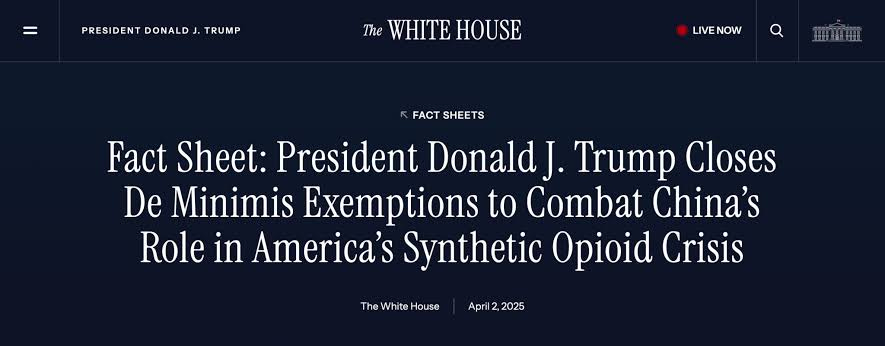
On 16 April 2025, in response to the United States’ suspension of Section 321’s duty-free de minimis and implementation of tariffs, Hongkong Post stopped accepting surface-mail items containing goods bound for the US. On 27 April, it stopped accepting air-mail goods. Letters could still be sent, but goods could not.
For most postal offices worldwide, the US is the largest destination lane. That means the revenues and gross profits are significant.
From 2024-205, Hongkong Post’s ecommerce revenue fell from HK$1.013 billion to HK$664 million, and ecommerce mail volume fell from 32.8 million items to 10.9 million. Just one years time.
The Government directly attributes the sharp volume decline to geopolitical conditions and tighter inbound-mail rules in different markets.
The U.S. suspension significantly reduced Hong Kong > US shipments for the entire market, and Hongkong Post’s loss of the lane resulted in heightened losses of revenues and pushed even more business into the hands of competitors.
5. 2026: Europe ends duty-free de-minimis
The United States was not the only market changing the rules.
From 1 July 2026, the European Union replaced the customs-duty relief previously available for qualifying low-value imports with a temporary €3 customs duty on goods in consignments worth up to €150. The charge was applied on a per-line-item-category basis, meaning one shipment containing two line items would be assessed €6.
While Hongkong Post did not close its EU lanes, the customs duty was nevertheless a new cost which made it far less attractive for the cross-border ecommerce shipping model, and which ultimately led to further losses of cross-border volumes for Hong Kong’s ecommerce ecosystem, and by extension Hong Kong Post.
6. Postal Operators offer poor DDP solutions
The EU’s customs policy change also created a new problem that posts all over the world are still suffering from - a poor customs and remittance system for shippers and receivers.
Hongkong Post’s own notice says the €3 duty will be settled at destination or collected directly from the recipient, depending on destination arrangements. That may be workable for an occasional sender. But for an ecommerce merchant trying to provide a smooth checkout experience, it is a different proposition from showing the final landed price before the parcel leaves the warehouse.
In the old postal model, the job was to collect a parcel, deliver it to the destination country and let the destination customs deal with the receiver for the rest. In modern cross-border ecommerce, the merchant and the customer increasingly expect a seamless customs-and-duties experience where the total price of duties and taxes is collected and settled upfront by the carrier. This is known as Delivered Duty Paid or DDP.
DDP = Delivered Duties Paid
While Universal Postal Union (UPU) has worked diligently to build a DDP system for this purpose, it’s solutions still require payment at post office through 3rd-party providers, and the solutions are not automatically offered by every post.
The available postal solutions are less user-friendly compared to the seamless DDP solutions offered by private carriers, thus driving further business away from the posts and into private carriers.
Recap
To understand Hongkong Post’s, we have to first understand the external market factors that shaped Hongkong Post’s development. In short, you can think of it as:
The Rise
The rise of Hong Kong as a global trading and financial centre
The boom of ecommerce
The Fall: Domestic
Letter mail decline
Competition from the private sector
Hong Kong ecommerce’s disintermediation by China ecommerce (domestic)
The Fall: Crossborder
Terminal dues increase
Hong Kong ecommerce’s disintermediation by China ecommerce (international)
Inability to access consumer electronics (battery) and beauty (liquid) shipments
2025 US de-minimis and tariffs
2026 EU de-minimis
Uncompetitive Delivered Duties Paid (DDP) solutions
What’s Next
In the traditional Hero story, every Hero will eventually enter The Abyss. This is the lowest point in the story, when the Hero feels that they have failed and that all is lost.
But Hong Kong Post is supposed to be the Hero of this story. The act that has yet to be written is The Transformation.
How can Hongkong Post transform itself and rise to the challenge?
Before we answer that, in our next articles on this series we’re going to look at:
How other posts have risen to their challenges and thrived in their markets while still fulfilling their Universal Service Obligations (USO).
Other Blog Articles on Hong Kong Post:
Sources
[1] Hongkong Post, FY2024/25 Financial Performance.
[2] Hong Kong Free Press, Hongkong Post ends permanent roles for new staff.
[3] CEDB, LCQ14: Future development of Hongkong Post.
[4] UPU Postal Statistics 2024.
[5] Hongkong Post, Corporate History; Hongkong Post Fact Sheet.
[6] LegCo Public Accounts Committee, Report No. 65, Appendix 50; Hongkong Post FY2014/15 Annual Report.
[7] Hongkong Post FY2016/17 Annual Report; FY2024/25 Annual Report.
[8] Hongkong Post FY2009/10 Annual Report, Contributions to International Initiatives; UPU Universal Postal Convention.
[9] SF Express Hong Kong; Cainiao Hong Kong; JD Logistics; DHL Express Hong Kong; FedEx Hong Kong; UPS Hong Kong; GoGoX; Lalamove Hong Kong.
[10] Cainiao, Expand Express Infrastructure with Over 1,000 Self-Pickup Points in Hong Kong.
[11] HKTDC, Cross-border Ecommerce Generates New Business Opportunities.
[12] Amazon Global Logistics; PDD Holdings 2024 Form 20-F.
[13] Hongkong Post, No Posting of Dangerous Articles.
[14] Hong Kong Civil Aviation Department, Dangerous Goods Information; Hong Kong International Airport, Air Cargo.
[16] CEDB, LCQ9: Staffing establishment and operational status of Hongkong Post.
[17] Hongkong Post, EU to levy EUR 3 customs duty on low-value postal packages; European Commission guidance.