

What Happened: Quick Snapshot
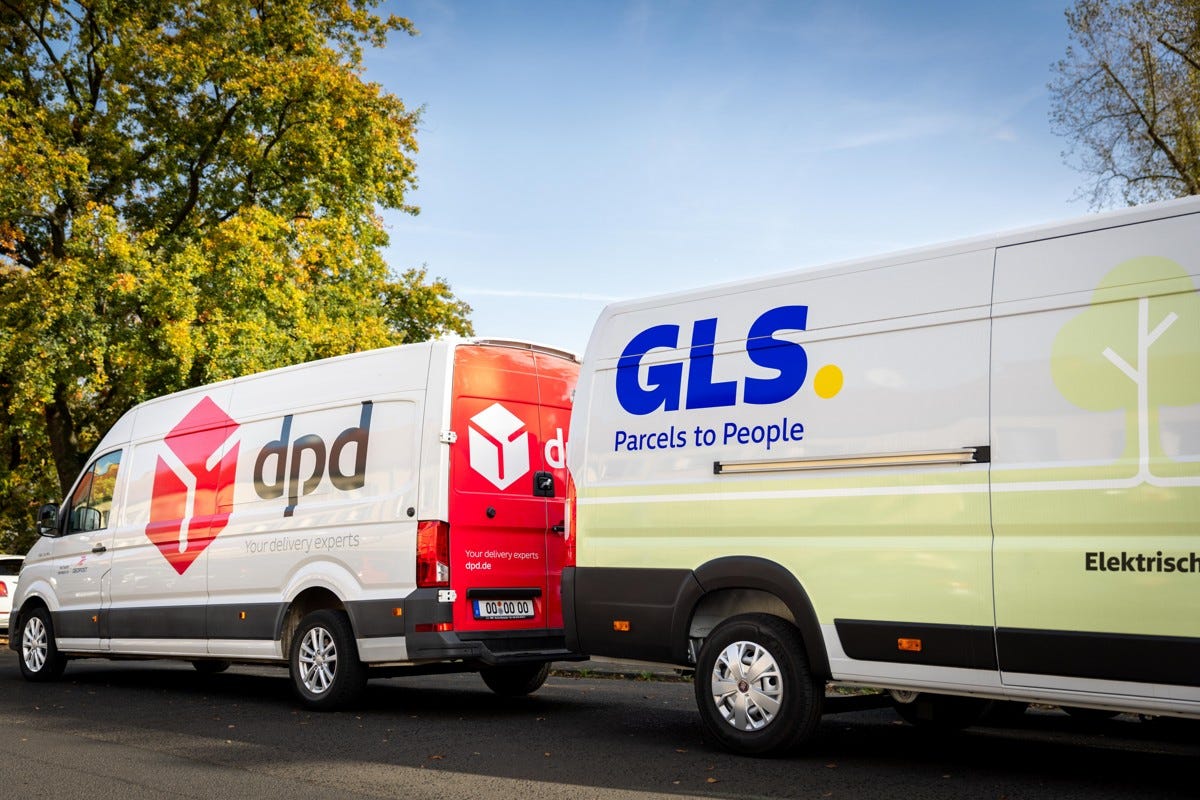
Last week’s surprise announcement of GLS Germany and DPD Germany’s merger shook up the Ecommerce Logistics world globally as both companies have a well known global footprint and operations.
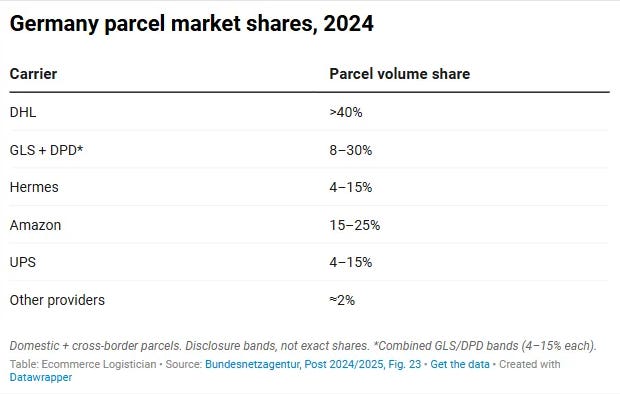
The combined companies are projected to generate over €4bn in annual revenue and handle over 700 million annual shipments, estimated to account for 20% market share.
The combined forces will operate under the banner of GLS with GLS owning 80%, and DPD owning 20%.
Interesting Fact: It Started with a Parcel Lockers
Andre Veskimeister was the first person to point out to me that this relationship was love at first parcel locker.
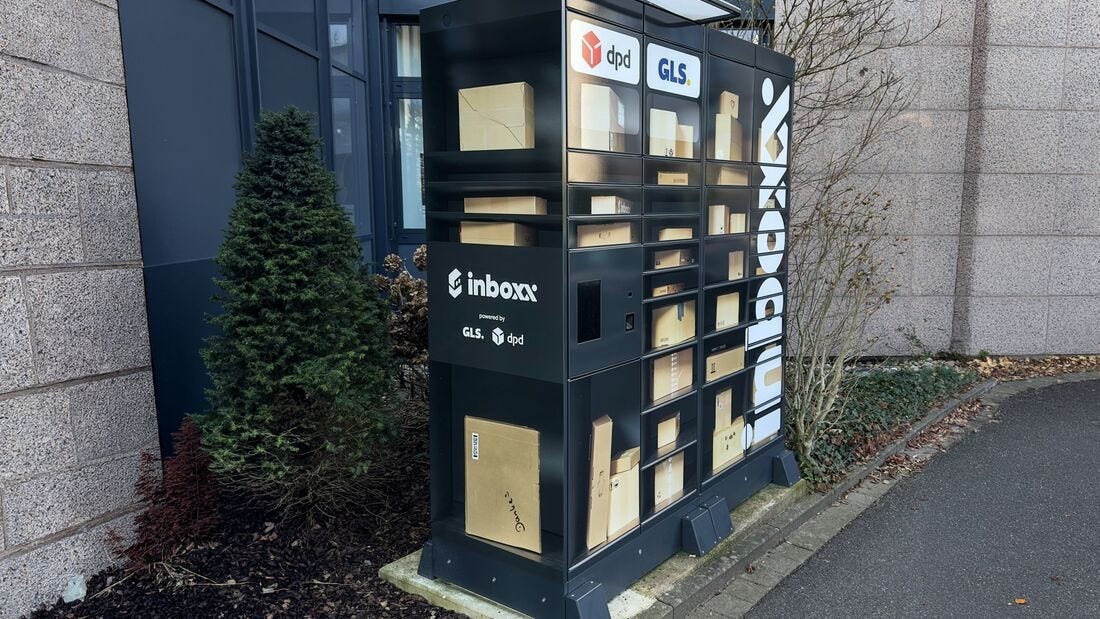
The two companies had first collaborated in 2024 through an agreement to share their parcel locker networks with each other, which ultimately led to the formation of inboxx - an open parcel locker network.
Smart Strategic Merger
1. Volumes
The merger makes at the most important foundational level in the ecommerce logistics business - the larger the volumes, the larger the opportunity to optimize.
We can witness this by observing both current-day FedEx and UPS, whom despite losing parcel volume market share within the US, are both undergoing profound operational optimization transformations which have resulted in measurable cost savings. FedEx reported more than US$1 billion in transformation-related savings in fiscal 2026, while UPS reported US$1.8 billion in achieved benefits from its network and efficiency programs in the first nine months of 2026. UPS’ U.S. domestic adjusted operating margin rose to 7.0% from 6.4% in the third quarter, even as average daily volume fell 3.3%.
GLS is uniquely positioned to pull of optimization projects and lead the combined group.
Between the largest players in Germany which include DHL, GLS, DPD, and Hermes, GLS as the most nimble and agile management based on their public track record of rapid growth, entry into new markets and business lines, M&A, and technology.
While DHL is similarly highly capable, it’s global operating scale means that it must act a little more slowly and deliberately.
DPD Germany is similarly one of the best DPD’s operationally, but the Geopost > DPD decentralized management puts the company at a severe disadvantage in executing the global strategy that today’s current challenges require.
Conversely, GLS is known to have strong centralized management while also having strong country specific managers to compliment.
2. Out of Home
With PUDO growing in the market and increasingly seen a vital to survival, both GLS and DPD lagged the other players in the market, but the combined companies are now squarely in the game.
The Real Challenges
While the merger is an incredibly smart strategic play which improves the foundations of the core business, such improvements by themselves doesn’t really change the big picture and doesn’t address some of the biggest challenges I see in the coming years.
1. Competition from Retailers-Turned-Logistics Companies
There is an existential challenge posed by the rise of retailers-as-logistics companies, a problem in which the world’s largest retailers are not only doing their own logistics in-house, but also becoming logistics services providers (LSPs) themselves and openly challenging traditional ecommerce logistics players.
This includes Amazon, Media Market (owned by JD), and Vinted to name a few. Owning more market share is a key foundation that needs to be shored up to take on this current challenge.
2. Competition for High Volume Low Cost Chinese Volumes
The retail landscape has been changing rapidly with the meteoric rise of “Chinese Dragons” which include Shein, Temu, Bytedance/TikTok, Taobao/Cainiao, and JD. These retailers and their customers are often more interested in lower cost delivery. As a result, a number of low cost parcel carriers including UniUni, GoFo, SpeedX, and SwiftX have entered various global markets and are scaling at breakneck speeds.
While the above named providers are not yet active in Germany, both GLS and DPD are not traditionally priced as low cost providers and this merger does not yet directly address the potential threat of such competitors gaining a hold in the market. It’s possible that the shared parcel locker network relieves the stress on the market for low cost solutions, but the German market needs to watch the US, Canadian, and UK markets closely to see how those play out.
3. Quick Commerce
With Quick Commerce reaching a frenzy in markets like China and India, and with it starting to make it’s way into the US and the UK, Quick Commerce poses and existential threat to the traditional ecommerce logistics service providers, because Quick Commerce relies on a completely parallel infrastructure that traditional ecommerce.
In the US, FedEx has already aligned itself with OneRail and UPS with Roadie in anticipation of the coming challenges. The current merger similarly does not yet help to address this threat.
Additional M&A
What interests me the most is how far the GLS + DPD relationship can go and whether this sets the stage for further GLS + DPD mergers in other markets.
There are few companies in the world that compete so directly across multiple markets and business lines.
Their key primary markets are in Europe
Both are positioned in most markets as neither express, nor lowest cost
Both have strong crossborder businesses intra Europe as well as North America and China
The weakness of DPD’s decentralized model applies globally. If the German market example is successful, DPD could have reason to merge other markets like Italy, Spain, Netherlands, etc. under GLS’ strong centralized leadership as well.
Foundations Are Set
Despite the challenges to be addressed, the current merger strengthens the foundation of GLS especially in a key market like Germany, where even gaining market share from DHL and Hermes would be enough to demonstrate large gains. If it can execute the merger well, it can then focus on the new challenges which loom in the horizon.