

Warning: While this post is not about ecommerce logistics, it’s relevant to any marketers in the ecommerce logistics ecosystem - so forward it to your marketing teams!
I post a lot on LinkedIn, and so I often get asked if posting content on LinkedIn can help companies get sales if they’re in professional services, SAAS, or logistics?
Usually this is from a company that has posted for a few weeks on their company channel, or done a few posts on their personal channel, and didn’t see any immediately attributable conversion.
The problem with trying to attribute ROI on content normally stems from a misunderstanding of what content is and how it impacts the modern B2B buyer journey.
Good content informs, educates, or entertains - and in today’s highly distracted society, “entertainment is the only currency today that can purchase the attention of a too-distracted public.” - Roy H Williams
Good content helps to build an audience and “audiences are an are an asset with quantifiable value” - Robert Rose Chief Strategy Advisor of CMI.
The problem with most companies, however, is that they’re stuck on outdated last touch attribution concepts, and they don’t understand the modern buyer’s journey.
Most companies I see are stuck on some form of McKinsey’s Consumer Decision Journey which visualizes the customer as going on a predictable straight line happy path where every marketing touch point pushes them closer to becoming a customer.

This is totally wrong for today’s highly distracted and overly informed world, and it’s exacerbated by popular CRM designs which model their UI’s around the same straight line funnelling.
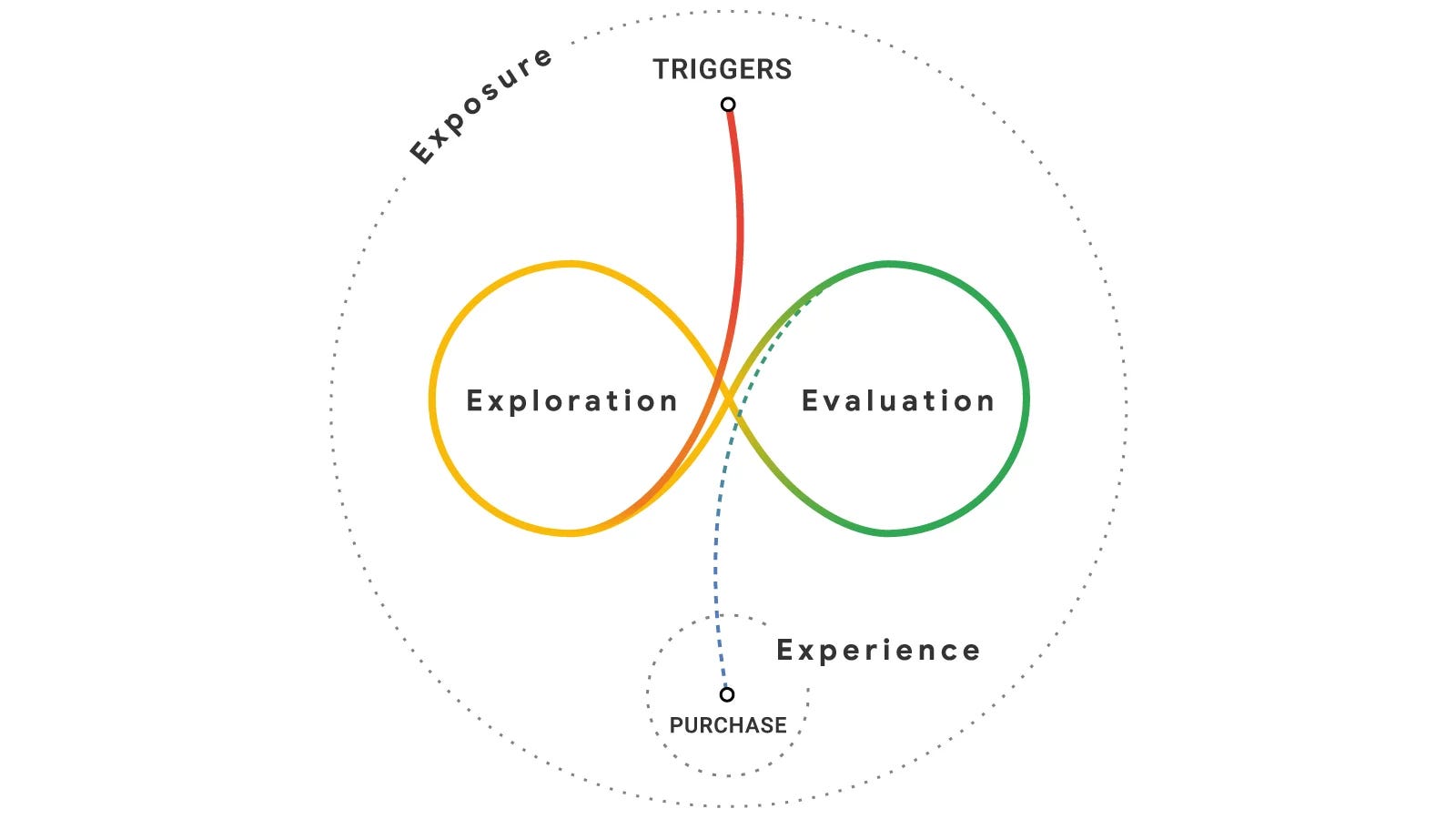
Google’s Messy Middle Framework more aptly descriptions the realty of today’s buyer - going through multiple loops of exploration and evaluation until they one day end up as a customer.
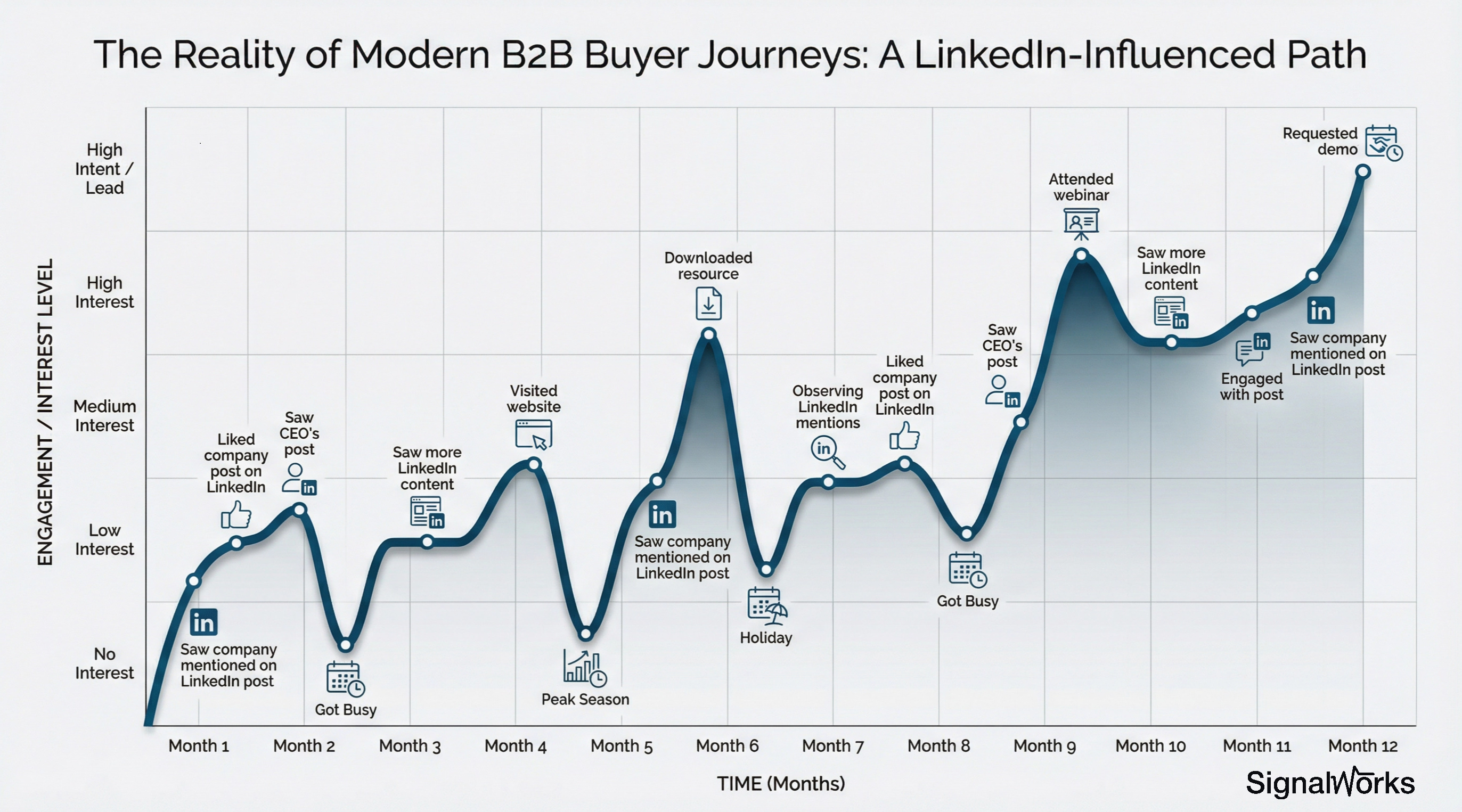
For B2B, however, where buyers are have real pain points to solve and goals to achieve, the journey is more like a slow crawl from 0 to CLOSE, with maybe was many as 50 touch points.
In today’s highly distracted and overly informed society, buyers are constantly getting micro signals which takes them through peaks and troughs of their pain points and goals.
Just think about yourself. You’ve bought products and services for your company.
Did you follow the McKinsey straight line?
I have a pain point!
Let me Google various providers
Next I’ll visit their websites
Fill out the forms
Have sales call with them all
Have a follow up calls with a short list
Ask for a quote from the final 1-2
Sign a contract
That’s the old world. It doesn’t exist anymore.
The modern B2B buyer’s experience is totally different from what last generation marketers tell you. In today’s highly distracted world of overwhelming information, the journey looks totally different.
Buyers start to feel some pain, not necessarily aware that they need to solve it, or they set some goals which they already have a plan for
Over months or years they see relevant content that informs, educates, or entertains them related to both their pain, and the possible solution(s) in the market, while in parallel
Their pain point or goals continue to grow until they hit a point where they are ready to pull the trigger
At this point they’ve already decided who they’re probably going to work with - the top 1-2 choices were already won over the months and years of seeing micro bits of content around their pain and the possibility solution, potentially as many as 50 touch points with a company
This is what I call, the Modern B2B Buyer Journey.
Two of the biggest excuses I usually hear at this point:
We can’t measure multi-touch attribution.
So instead we measure just the last-touch which is still better than measuring nothing at all.
While LinkedIn doesn’t show you all of the people who make up your impressions, LinkedIn does show you:
Who LIKED and commented on your posts - are you measuring them?
Who VIEWED your profile and your company’s profile - are you measuring them?
Measuring last-touch attribution is dangerous because once you understand the modern B2B buyer journey, last-touch attribution will lead you the WRONG conclusion.
There’s a reason that events and dinners have the highest ROI: because you were able to measure them.
If measuring multi-touch attribution is truly a challenge, an alternative quantifiable goal might be something like “We intend to achieve a 20% increase of in-ICP visitors to our personal pages and company pages this quarter.”
I guarantee you that the more content you post that informs, educates, or entertains, the more pipeline you will see.
STOP! Only subscribe to me if you’re in Ecommerce Logistics.