

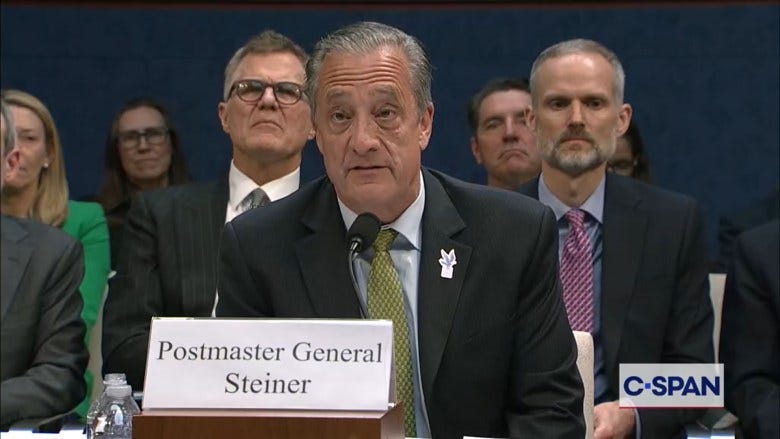
The United States Postal Service (USPS) is facing an existential crisis. With a $9B loss in 2025, and with traditional mail volumes in a state of irreversible decline, the post finds itself at a critical juncture.
In a March 2026 testimony before Congress, Postmaster General David Steiner laid out the gravity of the situation, warning that the USPS could run out of cash within 12 months.
His requests included (1) raising the agency’s debt ceiling, (2) increasing its pricing authority and (3) legislative “flexibility” regarding the Universal Service Obligation (USO) — the legal mandate that dictates that USPS provides accessible letter mail service to all residents, which is specifically codified to include a requirement for 6 days a week mail delivery.
The USO predicament is not unique to the United States.
Postal services around the world have been grappling with the same letter mail apocalypse for over a decade now. As email, social media, and electronic billing have replaced the physical letter, these legacy institutions have been forced to adapt or face insolvency.
To understand the potential paths forward for the USPS, let’s take a constructive look into what other nations have already done. Their experiences might offer a valuable blueprint and learning for what might be possible.
The Global Response to a Universal Challenge
Faced with similar pressures, postal operators worldwide pursued a wide range of strategies to align their costs with the new reality of declining letter mail volumes, moving beyond simple price increases to fundamentally restructure their operations and legal mandates.
Denmark (PostNord): Ceased letter delivery entirely (2025); mandatory digital mail (e-Boks);
Canada (Canada Post): Ending door-to-door delivery in favor of community mailboxes; reducing delivery frequency to 2-3 days/week for non-urgent mail.
United Kingdom (Royal Mail): Privatized in 2013; moved to 5-day/week delivery for 2nd Class mail; lobbying for further USO relaxation.
Norway (Posten Norge): Implemented alternate-day delivery; slowed service standards; workforce reduction of 33% since 2015.
Sweden (PostNord): Proactively implemented alternate-day delivery in many areas; seeking further regulatory relief.
Australia (Australia Post): Reduced regular letter delivery to every-other-day; extended delivery timeframes for all letters.
New Zealand (New Zealand Post): Reduced delivery to 2 days/week (urban) and 3 days/week (rural); reducing the number of required postal outlets.
Germany (Deutsche Post): Legislated slower delivery standards (95% of letters within 3 days, up from 2); scrapped next-day requirement.
Japan (Japan Post): Ended Saturday delivery; extended delivery times by one day; launched a “digital address” system.
Switzerland (Swiss Post): Integrating a digital letter into the statutory USO; harmonizing punctuality standards for letters and parcels.
France (La Poste): Maintains 6-day delivery but receives direct government compensation for the net cost of the USO.

Three Models of Postal Transformation
The various national strategies appear to fall into 1 of 3 approaches:
1. The Radical Pivot: The Danish Model
Denmark represents the most dramatic response to the letter mail apocalypse. After a 90% collapse in letter volume since 2000, PostNord, with the backing of the Danish government, made the decision to cease letter delivery entirely by the end of 2025.
The country has transitioned to a mandatory digital mail system via e-Boks, through which citizens are legally required to receive official communications from the government.
This decisive move effectively eliminated the economic justification for a national letter delivery network, allowing PostNord to pivot its entire infrastructure and focus exclusively on the growing and competitive parcel market.
2. Pragmatic Reductions: The Alternate-Day Approach
A more common strategy, adopted by countries like Norway, Sweden, Australia, and New Zealand, has been to reduce the frequency of delivery rather than eliminate it.
Norway moved to alternate-day delivery in 2016, a move that, combined with other reforms, cut operating costs in its mail division by approximately 35%.
Similarly, Australia Post is in the process of rolling out every-other-day delivery for regular letters nationwide, a reform projected to deliver a significant improvement to its financial position after a $200.3 million loss in FY2023.
This model preserves the concept of a universally accessible mail service but adjusts the service level to match modern demand and fiscal constraints.
3. Structural and Legislative Adjustments
Other nations have focused on changing the underlying rules of the game.
Canada Post is systematically ending door-to-door delivery for its remaining customers, transitioning them to more cost-effective community mailboxes—a move expected to generate nearly $400 million in annual savings.
In Germany, the government modernized its Postal Act by scrapping the next-day delivery requirement and formally legislating a slower, 3-day standard for the vast majority of letters, giving Deutsche Post crucial operational flexibility and cost savings.
The United Kingdom took the path of privatization with Royal Mail, which has since moved to five-day delivery for second-class mail and continues to lobby its regulator, Ofcom, for further relaxation of its USO.
In France, the government has taken a different approach, maintaining a six-day delivery mandate but providing La Poste with direct state compensation for the net cost of fulfilling this public service obligation.
The Unspoken Choice Before the United States
The debate sparked by Postmaster General Steiner’s testimony is not merely about accounting or borrowing limits; it is about defining the purpose and structure of a national postal service in the 21st century.
The path forward for the USPS can be seen through the lens of the global models:
Maintain the Status Quo: This involves continuing to fund the current 6-day delivery model through increased borrowing and higher stamp prices. As international examples suggest, this approach may provide temporary relief but fails to address the fundamental structural decline and is likely to lead to recurring financial crises.
Incremental Modernization: This path would involve Congress amending the Postal Service Reform Act of 2022 to allow for a reduction in delivery frequency, similar to the models in Australia or Norway. This would represent a significant cost-saving measure while preserving a nationwide mail delivery network.
Radical Reinvention: A more long-term and disruptive path might involve a deliberate, multi-year strategy to transition away from physical letters as the primary means of communication, embracing digital identity services, and reorienting the USPS infrastructure around the competitive parcel market, mirroring the strategic direction of Denmark and others. Whether this is right for the US or not is another discussion, but we can at least study and learn from other countries.
If you enjoyed this article please subscribe to the blog