


Three years ago, I stood on a stage at the GS1 Summit in Hong Kong and told a room full of senior logistics professionals that AI was coming for their jobs. The response: a sea of deer-in-the-headlights stares. The silence was uncomfortable. You could feel the collective thought in the room: “Another tech guy who doesn’t get that our business can’t be automated.” The moderator quickly moved on. I was never invited back.
Fast forward to today: Cold hard numbers dance around our screens informing us of large layoff announcements. Economists note continued reductions of professional white-collar job postings. At the same time, logistics companies post record earnings.
Don’t take my word for it. Just look at the receipts from the last 18 months.
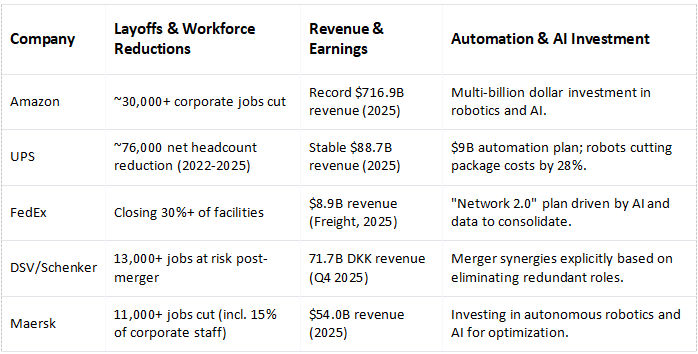
The message is undeniable: companies are making more money while adjusting their workforce. Amazon’s corporate workforce—the knowledge workers, the managers, the strategists—has been systematically reduced while the company’s revenue grew by over 50% since its headcount peak. The warehouse workers largely kept their jobs. The office workers did not.
This culling is happening because the very fabric of the logistics profession is being disassembled. The job of a freight forwarder, once a complex dance of phone calls, emails, and spreadsheets, paired with knowledge, experience, and wit, is now being broken apart into tasks that software can now perform flawlessly.
Rate and quote desks are being replaced by digital workers that turn a 45-minute hunt into a 4-second query. Documentation and customs clerks are watching as AI auto-fills bills of lading and validates customs entries. Customer service agents are being bypassed by CS bots that are always online, answer immediately, and never get angry.
Managers: you’re next. For years, innovation teams in logistics have been obsessed with the ‘digital twin’—building digital replicas of warehouses, container fleets, and entire supply chains to simulate, test, and optimize the flow of physical goods. But while we were all preoccupied with modeling our assets, our companies have inadvertently been laying the foundation of creating a digital twin of something far more valuable and far more vulnerable: YOU.

Every email you write, every document you create, every strategy presentation you formulate is corporate property. This digital mental footprint is now the training data for your own replacement. Your experience, your knowledge, your very thought process—codified and owned by the company—can soon be used to build an AI that can do your job without your salary.
This is not a hypothetical. In October 2025, Business Insider reported that the cloud platform Vercel trained an AI agent on its top-performing salesperson, shadowed them for weeks, and then built an AI to replicate their entire workflow. The result? A 10-person sales team was transformed; one person now supervises the AI, while the other nine were reassigned to higher-value outbound prospecting roles. As industry analyst Josh Bersin notes, when a senior employee leaves, their “digital twin”—their knowledge and persona—remains as a company asset. Even the C-Suite is not immune; a New York Times report suggested 80% of a CEO’s work can be automated.
The consequence of this automation is a flood of talent into a shrinking job market. In 2025, the recruiting firm SCM Talent Group reported a 128% spike in resume submissions for supply chain roles. The market is saturated with experienced professionals at the exact moment the number of senior roles is collapsing.
For the thousands of seasoned logistics professionals now finding their roles redundant, there is a silver lining. At least we have enough logistics experience that we will probably make great food delivery carriers.
Love the article, very informative and insightful especially the food delivery driver piece
😀